SanadOS
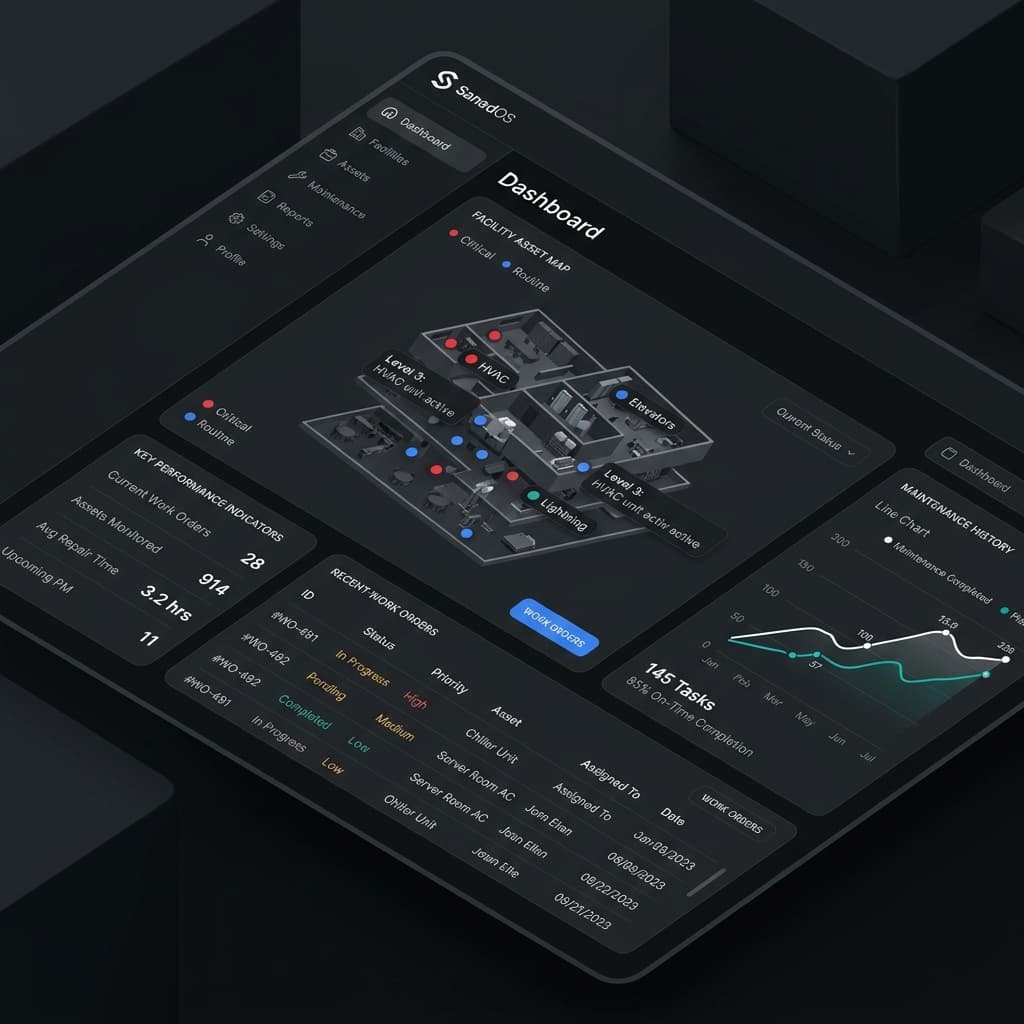
Unified platform for facility operators to track assets, manage work orders, and maintain comprehensive audit logs all in one place.
SanadOS
Project overview
Introduction
SanadOS is a facilities operations platform built to bring asset tracking, work orders, and maintenance history into one system of record. It is currently in pilot with real facility operators, and the workflows described here are being validated and adjusted based on that pilot rather than treated as a finished, general-availability product.
The Problem
Facility teams often end up tracking assets, work orders, and maintenance history across a spreadsheet per building, plus whatever notes technicians keep on paper or in messaging threads. That split makes it hard to see an asset's condition, a work order's status, or a full maintenance history in one place, and it leaves audit trails incomplete or scattered across files that are easy to lose or overwrite.
The Technology
SanadOS is built with React on the front end and Supabase on the back end, using Supabase's Postgres-based data layer along with its real-time and authentication features to keep asset and work-order records synced across users. An AI component is part of the stack; exactly what it assists with in the day-to-day workflow is one of the things the pilot is being used to validate, rather than a fixed, finished feature set.
Key Features
- Asset Tracking: A central record for each facility asset, instead of one spreadsheet per building.
- Work Order Management: Work orders that can be created, assigned, and tracked through to completion.
- Audit Logs: A record of activity on assets and work orders, intended to support accountability and review.
- Real-Time Data: Built on Supabase so records stay in sync as multiple users update them.
Target Use Cases
- Facility and Operations Teams: Teams responsible for the assets and maintenance of one or more buildings.
- Multi-Building Operators: Organizations currently running a separate spreadsheet per site that want one shared system instead.
- Field Technicians: Staff who need to update work orders and asset status as part of their day-to-day work, subject to the device and offline requirements confirmed for each pilot.
Key Benefits
- One System of Record: Replaces a spreadsheet-per-building approach with a single place for assets, work orders, and maintenance history.
- Accountability: Audit logs are intended to make it clearer who did what to which asset, and when.
- Shaped by Real Use: Because it is in pilot with real operators, the workflows are being adjusted against actual day-to-day use rather than assumptions.
- What replaces the spreadsheets, concretely?
- One system of record: every asset, every work order, and its full maintenance history — searchable, assignable, and auditable.
- Is it in production?
- No — it is in pilot with real operators. Status here is stated exactly as it is.
- Who is SanadOS designed for?
- It is designed for facility and operations teams that need one place for assets, work orders, maintenance history, assignments, and audit records. The exact workflows are shaped with the pilot operators.
- Can technicians use it from the field?
- The workflow can support mobile-friendly work orders, status updates, asset details, and maintenance notes. Device and offline requirements should be confirmed before finalizing the pilot scope.
- What does the pilot validate?
- The pilot validates whether the asset model, work-order flow, permissions, reporting, and day-to-day adoption fit the operator's real process. It is not presented as proof that every facility will need the same configuration.
- Is there a public repository or live demo for SanadOS?
- No. SanadOS doesn't have a public GitHub repo linked — it's private and unlisted at this stage. Access is arranged directly for anyone evaluating the pilot.
- What exactly does the AI component in SanadOS do?
- That's still being defined through the pilot. AI is part of the stack, but which tasks it assists with in day-to-day operations is being validated with real operators rather than fixed in advance.
- Why Supabase instead of a custom backend?
- Supabase gives a Postgres-based data layer with real-time sync and authentication out of the box, which fits a tool where multiple people need to see the same asset and work-order records update live. That's the reasoning behind the choice, not a claim that it's the only workable option.
- How complete is the audit log feature right now?
- It's part of the current pilot scope — it records activity on assets and work orders, and its exact level of detail is being refined against what the pilot operators actually need for accountability and review.
Ready to engineer your custom system?
Let's build resilient, mission-critical infrastructure for your operations.